I talk with Maia Chao (director) and Lena Engelstein (choreographer) to talk about American Idle, their public performance work of doppelgangers shown on July 9, 2025 in the middle of Times Sqaure. We discuss how projection and reality, symbol and intimacy, meet in the busy hyperreal zone of Times Square through a performance of doubles. Read the interview here.
Category: Essays, Interviews, and Published Work
-
The Brooklyn Rail: Generating Glory
In Generator, Neva Guido pushes out a string of shining personas to investigate the performances that make up a spectacular world. I reflect and respond in this essay, which can be read here.
-
Danspace Project Journal: Everything and Nothing
In this essay, I ask epic questions alongside reflections on a shared evening of dance by Jade Manns and Glenn Potter-Takata that premiered at Danspace Project in December, 2024. Read or listen to the article here.
-
Danspace Project Journal: there were always more than one: reflecting on Andros Zins-Browne’s “duel H”
I write in response to Andros Zins-Browne’s new work, from the position of a dance artist, former staff member of Danspace Project, and PhD student in Performance Studies. In this reflection, I draw from my knowledge of St. Mark’s Church, conversations with Zins-Browne, and writing from scholar and poet, Fred Moten, who is an advisor of my academic work. The full text can be read or listened to on Danspace Project’s Journal.
-
Movement Research Performance Journal Issue #58/59: Fragile Fall / A conversation between Nora Raine Thompson and Nacera Belaza
This conversation follows my inquiries into the impossible and infinite realms of Nacera Belaza’s choreographic process. MRPJ #58/59 can be purchased on Movement Research’s website.
-
The Brooklyn Rail: In The Room
This essay is a meditation on Chloë Engel and Anna Kroll’s collaborative imagination practice, and was first printed as an exhibition catalogue accompanying Anna Kroll’s MFA show at the University of Maryland. It was later published by The Brooklyn Rail in their September 2023 issue. Read a short excerpt below, and the full essay on The Brooklyn Rail’s website.
In The Room, we enter a realm of impossibility. Ears can catch fire, legs can be swings, and I can be a moth, crying at the funeral of a praying mantis. We build The Room ourselves. In it, impossible things become possible. We announce observations, movements, sensations, and decisions to each other. What is said is possible, plausible, done.
-
Danspace Project Journal: Tilting the Mirror
In this essay in Issue 15 of Danspace Project’s Journal, I reflect on Joan Jonas and Eiko Otake’s unique and historic collaborative performance and installation, Drawing in Circles WHY (an experiment), presented at the Castelli Gallery in partnership with Danspace Project. Please read an excerpt below, or read or listen to the full piece on Danspace Project’s website.
Eiko and Joan move curiously but without hesitation, with purpose yet without any insistence on a particular narrative. Through this focused, inquisitive work, the importance of serious playful experimentation emerges. Eiko and Joan, though each with remarkable and established styles and identities cultivated over decades, are instructive in how to keep experimenting wholeheartedly.
-
The Brooklyn Rail: Sharing Opacity
This writing was published in The Brooklyn Rail’s November 2022 Issue as part of “VESSEL: Seeing Double,” parallel reviews by Noa Weiss and myself of David Thomson’s new work, VESSEL, which premiered at The Chocolate Factory in New York in October 2022. Read an excerpt below, and read the full interview on The Brooklyn Rail’s website.
One performer, shrouded in a blanket, approaches the walls often, a sliver of their face exposed, though nearly impossible to make out. They emit soft mouthy clicking sounds, like the echolocation of a bat. I can only hear them when their body is less than a foot away from mine, which gives me a glimpse of clarity and closeness, even while muffled visually by the veil between us. Opacity, Thomson shows us, does not preclude intimacy.
-
The Brooklyn Rail: In Conversation with Audre Wirtanen
This writing was published in The Brooklyn Rail’s April 2021 Issue. Read my introduction below, and read or listen to the full interview on The Brooklyn Rail’s website.
On March 5, 2020, Audre Wirtanen danced through a stage of props—an IV stand, clipboards, doctor’s chairs—recounting experiences of mistreatment and misdiagnosis from systems that promised care. She impersonated doctors who hit on her and then ignored her, and read, word-for-word, the founder of Alexander Technique’s eugenics-laden writing. Her work, DX ME FIX ME, was one of the last performances I experienced in-person, at Gibney Dance.
I thought of this piece frequently over the past year, not only because the pandemic made ableism’s entrenchment glaringly apparent, but also because Audre’s organization—Hyp-ACCESS, founded with collaborator Laura Tuthall—has been busier than ever. Audre and Laura began Hyp-ACCESS to address the communal autonomy and quality of life of people with Hypermobile conditions. If you’ve never heard of hypermobility, I recommend exploring their website, which is a trove of information on Hypermobile conditions and disabilities, their neglect in medical systems, and their exploitation in the performing arts.
Audre and I spoke on Zoom in early March, 2021, like a strange one-year-anniversary ritual for her performance. Over a couple hours, we laughed about bad doctors, considered the fetishization of pain in dance, and imagined healthcare that actually cares.
-
Danspace Project’s Utterances From The Chorus, Volume II: being with and letting go
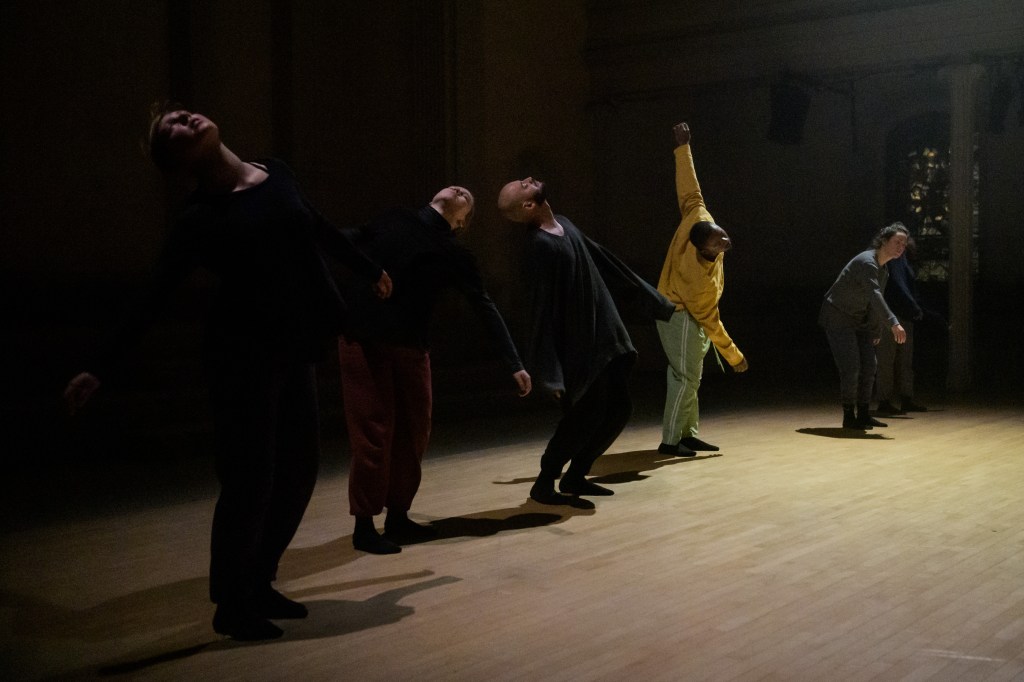
Photo by Ian Douglas This writing was published as a part of Danspace Project’s Volume II of PLATFORM 2020: Utterances From The Chorus, a virtual catalogue that contains memories and reflections of the multi-week Platform. Read an excerpt below, and read the full essay here, on page 27.
In the sanctuary, teetering on the edge of performance, we expand our internal worlds with effortful abandon until they swallow each other up, holding each other in the corners of eyes bumping shoulders shifting breathing air…The work was so much more complicated than transcending or ascending or emptying or filling up. [Nacera] wasn’t asking us to erase history. She was prompting us to discover what we needed to let go to become vulnerable. She was pointing us towards our specific, personal ways of cracking open. Let go, let go, let go, let go, let go.
 NORA RAINE THOMPSON