Image reads:
retrofit
improv worlds are so fun
colorful cluttered full
especially when on edge of life real
arched feet betray the dance
things are falling
eyes scanning
lets ruin it together
Image reads:
retrofit
improv worlds are so fun
colorful cluttered full
especially when on edge of life real
arched feet betray the dance
things are falling
eyes scanning
lets ruin it together
Image reads:
storyboard p
how do you get in the zone?
i look for where i’m lying to myself
smooth and shaky
precarity, often near edges
he keeps surprising
when he slows down ah
out on bail
shoes often skimming audience members, gently
eddie on stage, his mother weeping
smiles and eye contact and watching you
see me seeing you i see you brian seibert
from the new york times
trying to get old white people to be hype
who are all of you? he kept asking
manager passing out cards
five cameras filming
who was the q&a for?
we were all tired
This writing was published in The Brooklyn Rail’s April 2021 Issue. Read my introduction below, and read or listen to the full interview on The Brooklyn Rail’s website.
On March 5, 2020, Audre Wirtanen danced through a stage of props—an IV stand, clipboards, doctor’s chairs—recounting experiences of mistreatment and misdiagnosis from systems that promised care. She impersonated doctors who hit on her and then ignored her, and read, word-for-word, the founder of Alexander Technique’s eugenics-laden writing. Her work, DX ME FIX ME, was one of the last performances I experienced in-person, at Gibney Dance.
I thought of this piece frequently over the past year, not only because the pandemic made ableism’s entrenchment glaringly apparent, but also because Audre’s organization—Hyp-ACCESS, founded with collaborator Laura Tuthall—has been busier than ever. Audre and Laura began Hyp-ACCESS to address the communal autonomy and quality of life of people with Hypermobile conditions. If you’ve never heard of hypermobility, I recommend exploring their website, which is a trove of information on Hypermobile conditions and disabilities, their neglect in medical systems, and their exploitation in the performing arts.
Audre and I spoke on Zoom in early March, 2021, like a strange one-year-anniversary ritual for her performance. Over a couple hours, we laughed about bad doctors, considered the fetishization of pain in dance, and imagined healthcare that actually cares.
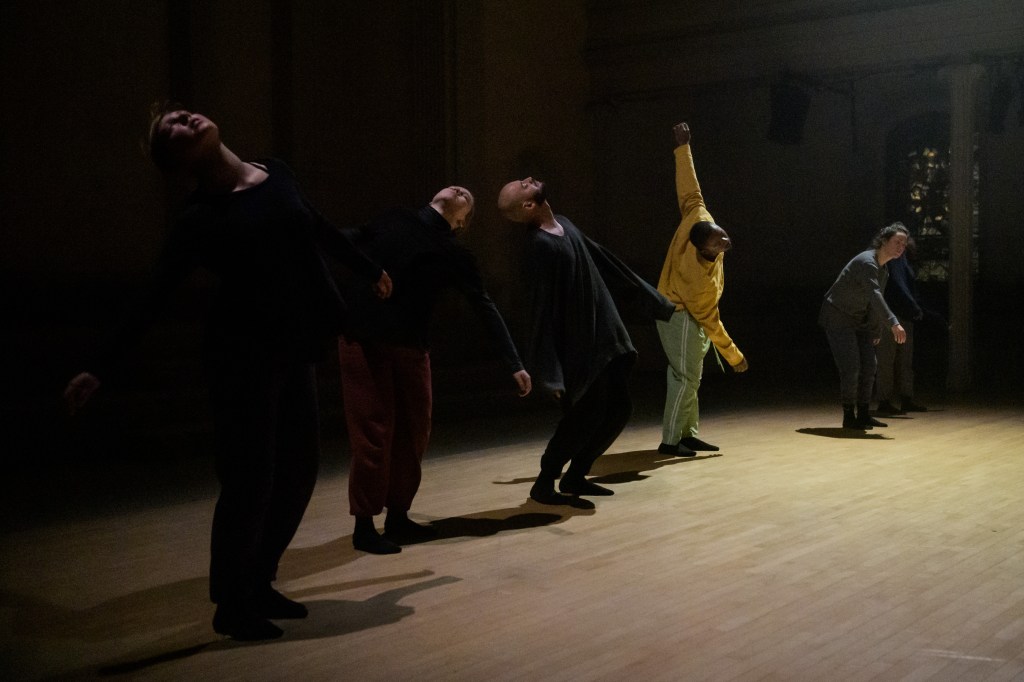
This writing was published as a part of Danspace Project’s Volume II of PLATFORM 2020: Utterances From The Chorus, a virtual catalogue that contains memories and reflections of the multi-week Platform. Read an excerpt below, and read the full essay here, on page 27.
In the sanctuary, teetering on the edge of performance, we expand our internal worlds with effortful abandon until they swallow each other up, holding each other in the corners of eyes bumping shoulders shifting breathing air…The work was so much more complicated than transcending or ascending or emptying or filling up. [Nacera] wasn’t asking us to erase history. She was prompting us to discover what we needed to let go to become vulnerable. She was pointing us towards our specific, personal ways of cracking open. Let go, let go, let go, let go, let go.
I am in Green-Wood Cemetery, on my birthday, beside my parents. We are planted on a grassy slope among stone grave markers, eyes trained on Eiko–my mentor, employer, former professor, who I haven’t seen in six months. I haven’t seen her because of the pandemic, because so many people are dying. It feels right we meet again here, among monuments to the dead.
She enters a verdant clearing created by a ring of tombstones, walking dutifully, slowly. The circle was there long before Eiko decided to perform there, of course, but it feels as if the dead are holding a seance for her, rounding themselves up to watch the one living being. Or maybe she is the medium, the one who can transcend the boundary.
She carries “red,” what I know to be her late mother’s scarlet kimono that’s travelled with her to irradiated Fukushima, to Chile, to Wall Street. She brings so much life and death along with her.
Her carrying is repeated over and over. Carry red. Carry water. Carry dirt. But it is not greedy. She lays down red, pours water, spits out dirt. She is in exchange with her ring of dead collaborators, spreading the stuff of living and dying around. Dirt smeared on her white dress, water sinking into her skin and drenching slabs of stone.
Despite the striking scene, I am prone to distraction. It is my birthday, and so I have listened to Stevie Wonder’s “Happy Birthday” several times that day, and it is circulating in my head, clashing with Eiko’s somber acts. My vision keeps jumping from her lean frame to the metallic teal balloon and yellow pinwheel staked purposefully beside two tombstones–they spin and bounce with the shifts of the wind, shrieking for attention, much like the persistently upbeat tune in my mind. And I can’t help but feel a distinct excitement in watching “live” performance for the first time in six months, acutely aware of all the breathing beings around me.
I recall a voicemail from a friend I listened to earlier that morning–she had recorded minutes of sweet musings for me, knowing we might not have time to talk on the phone. She is in upstate New York, looking around her:
Today, here, it’s pre-rain, so the sky is not blue or white but somehow both. The trees are orange and yellow and green. They are just in that in-between point. I think it’s so perfect for you and your beauty of in-between-ness. I hope you appreciate your in-between-ness, even though it causes you stress, or makes you feel unsure or groundless. These trees are in between themselves. The sky is in between itself. It’s perfect.”
I believe my friend that I am full of in-betweenness, a Libra, so of course. And I know there is much more foggy in-between-ness to be found right in front of me. I try to let my distraction, my selfish birthday egotism, bleed into my watching of Eiko. She is somehow getting in between my life-focused, groundless mood and the rooted heavy stones of the passed. I let her.
Eiko has a way of finding the blurry spaces between death and life, smudging the binary that we use to keep the unknown at a distance. I have already seen her practice dying alongside young dancers, and dancing with dead friends–their poems, their overcoats. Here she spreads soil and sinks bare feet into the lawn fed by remains and wraps obelisks in cloths and wetness. With these ritual acts of service Eiko reminds me of the constant in-between-ness beyond myself.
Audre’s handout, passed around after the performance of her new work, DX ME FIX ME, guides us, the audience, in how to engage with her work. Before asking us to reflect on what we experienced, she writes “Check in with yourself” “Notice you are breathing, you are on the ground.” With these directives, I feel cared for. She had anticipated that I might need this. She had preemptively empathized with her audience. I feel cared for, and immediately notice (as per the next instruction “What did you notice about this piece?”) that she did not get this same level of care from the doctors she described, impersonated, and portrayed in her work. None of them attempted to preemptively empathize. They were the “the men who fucked me,” as she writes on a giant post-it pad in the middle of the stage at one point during the piece.
She also asks us, through the handout like a portal from her brain to mine (I am neurotypical, I am not disabled, I have not dealt with doubt of doctors as she has, and I think she is talking to me), “Do you feel bad for me?” “Did it scare you?” “Are you trying to analyze whether or not this piece is real?” These questions give words to ideas that had only started to form in my subconscious–she gets out ahead of them. She also asserts “Eugenics is real.” She insists “Be ANGRY” “Be LISTENING” “Be willing to LEARN.” She provides resources and readings and podcasts to do the anger and the listening and the learning. This clarity, authority, and passion is solidified in this document, but has already percolated through her work I just witnessed. She is unafraid of confrontation and explicitness, and unafraid of dense nuance.
The work itself began with a “content warning” Audre wrote on a big pad of paper. This also serves as explicit context for the work, a guide of sorts. “Eugenics.” “Sexism.” “Ableism.” I consider my able, femme body. I consider my entrenchment in western biomedicine through a doctor grandfather, a doctor aunt, a doctor sister. I consider my embeddedness in the world of dance and somatics, my fairly smooth and rosy experience through it from liberal arts college to NYC. I try to consider my ableist gaze then and now.
In DX ME FIX ME, Audre travels among her stage of props, a world she seems steeped in–a book, a blazer, an IV stand, clipboards, doctor’s stools, cups of yellowish liquid–telling us her near-diagnosis, or more aptly, misdiagnosis, of P.N.E.S.
One of her first stops is at a book written by the founder of Alexander Technique, a somatic practice that attempts to release the body of tension and create balance. She reads from the book in an almost-mocking tone about “disability finally being eliminated” and the “evils of bad habits.” She is presenting written evidence of eugenicist rhetoric in somatics, showing clearly how we are told the body is something to fix. She lowers the book over her face, her body prone on the floor, reading reading reading until the pages seem to drown her voice. She is smothered, and I wonder if there is room for a body that can’t be “fixed” or doesn’t want to be “fixed” in that book. She throws it across the stage. I am ready to get angry with her.
She tells the audience, with a colloquial tone but using specific medical language, about her doctor’s visits, traveling from a clipboard to the giant note pad to an imagined doctor’s office. I learn a cohesive narrative of a search for an explanation for involuntary movements. I hear lists of symptoms, names of men, diagnoses, and endless experiments. I meet those who have tried to fix her–she embodies doctors she’s seen, making easy fun of their “masc-cis-het energy.” In the first of these meetings, Audre, after spending three days tethered to a wall in a hospital by wires and stickers that measure her movements, is met by a doctor who is stand-off-ish, literally–he won’t even come into her room. A psychiatrist is hunched and indifferent as he asks about her history of trauma, while Audre flips her body over and over trying to explain it. An “expert” is manspreading and inching towards her, telling her she’s attractive. Her pants are removed by her hands but I can’t be sure if they are her hands, really. I can feel his gross sexualized paternalism from my seat. By playing them she exposes them and we get to laugh at them together. I am angry.
Throughout, when playing herself or acting as a narrator, her movement is slippery and self-assured. She dances with her top half exposed except for EKG stickers covering her breasts, and her casualness makes me forget she isn’t wearing a shirt. She bends herself through a folding chair, glides softly in a rolling stool. She is constantly moving when playing herself, working working working to provide enough information (proof?) of her symptoms and pain. When she learns from a doctor about P.N.E.S., defined at one point as the brain “converting stress into physiologic symptoms,” she shares its many names: P.N.E.S. was once conversion disorder, which was once hysteria, which was once was the medicalization of witchcraft. She is floating while telling us this, spinning on a stool, her limbs slicing air with a kind of weightlessness. Her voice sounds almost giddy at the ridiculousness of being diagnosed with behavioral “spells.” I feel entranced.
Later she traverses her long row of clipboards, pulling on hospital socks and a blazer. She rubs a piece of paper over her skin (which I later find out is the business card of a social worker who hit on her during a consultation), bites it, chews it, swallows it down with a plastic cup of yellow liquid, her eyes trained forward steadfastly, determinedly. I wonder if this is how it feels to try to ingest and adjust to diagnoses, attempting to integrate them into the body. Or if this is how it feels to “follow doctors’ orders” or maybe to do the opposite. Or maybe if this is how it feels to get bullshit diagnoses that feel as useful as a tiny piece of paper slipping down the esophagus, washed down with sugar water. She ends this trek at a mirror where she readjusts her hair, methodically paints her lips, and recites the history of “hysteria.”
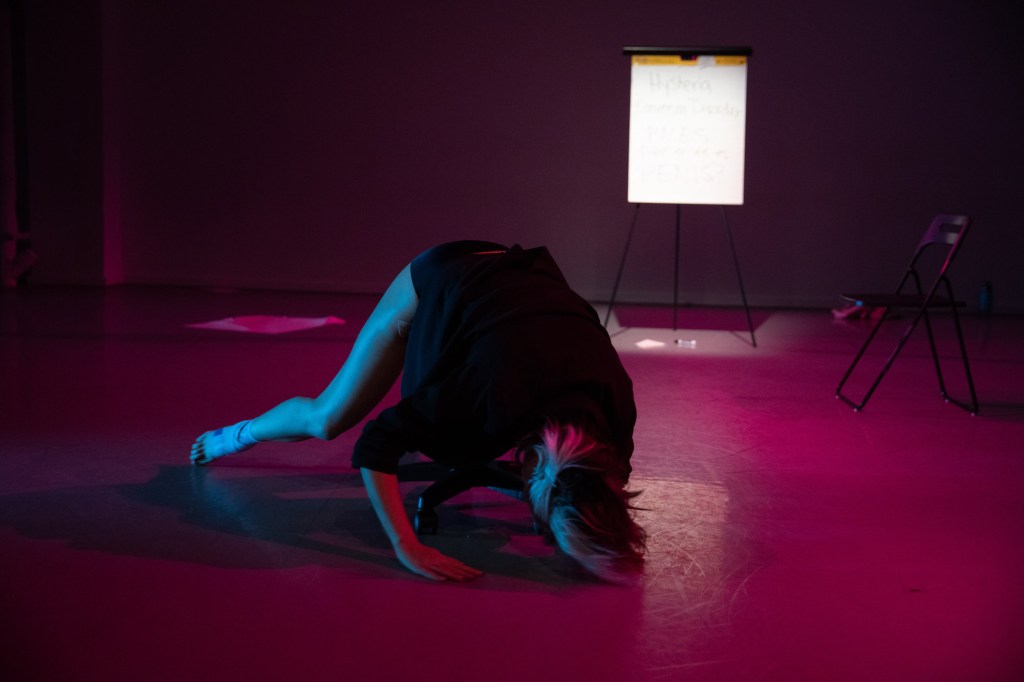
In what feels like the climax of the piece, Audre has pressed her belly into the doctor’s stool and uses her hands to spin herself, her head hanging and her legs outstretched. She speaks words at herself. They are someone else’s words, but seem to have been bouncing (spinning?) in her head for a long time:
I told you, it’s your thinking that’s the problem! You could help yourself but you are not thinking! You are the reason you are sick! You can think your way out of your body. I have. I can help you. I can fix you.
These words are familiar to me, more than the lists of symptoms or diagnoses. I have heard the promises of somatics and meditation and yoga and postmodern dance over and over again. I have chased the idea of being able to fix myself, of exiting the truth of my body or the reality of my history and transcending into some sort of “freedom.” I have been told to think my way out of my body too. I know my understanding of this rhetoric is limited–I am able, I am white, I have class privilege. But I see that these words and promises of fixing do not constitute care.
DX ME FIX ME is dense, packed not only with objects but also with medical vernacular, singing, heavy memories, and frank statements. I find it hard to summarize the experience in its entirety. But maybe this is the nature of her experience in searching for answers that are elusive and manipulated. She has shown me how much proof it takes to be taken seriously, how much authority she has to show to be believed, how much labor she has to do to just get some fucking care. She has repeated the exercise here on the stage; I have been confronted with the reality of eugenics, manifested in stand-offish doctors and sexist diagnoses and dismissive men and ableist somatics work. I am angry, I am listening, I am learning.
I’m so tired. I can’t figure out why. I’ve sat in front of a laptop researching disaster grants all day, but the government website keeps crashing. I baked cookies. I walked down my rainy street, veering back and forth to maintain the distance between masked neighbors. These things should not make me tired.
I receive a message from a Danspace Project member who never got to go to Okwui Okpokwasili and Peter Born’s Sitting On a Man’s Head before the pandemic required we cancel the final performances. Weeks ago, he had asked me how long he should set aside to participate. I had sent him a detailed account of my experience at the dress rehearsal, from the writing, to the waiting, to the watching, to the walking. I waffled a bit on how long he’d need, but decided on “as long as you can.” Immersing myself in slow walking had been healing and cathartic, and I had never wanted it to end. I had written in that email (and many others) that I wished Sitting On a Man’s Head could happen every week for the rest of my life.
Today, he thanks me for my account, noting that my email will be his version of the work. My eyes rest on his words, and I want to be transported back to when we all could breathe in the same spaces, touch hands.
I remember with a start the secret recording I had made on opening night. I had forgotten that after I exited the tent and settled on a riser, I watched and listened as more participants seeped out. I had forgotten my impulse to press record on my phone, something similar to the way I write haphazard notes in the “drafts” folder of my email whenever I feel awash in emotion. Maybe more like how I never delete voicemails.
I send the recording to myself. I need to hear it through better speakers than my old phone. I hope it isn’t just mumbles. I press play.
I had forgotten that at the close of the opening night of Sitting On a Man’s Head the collective of people sang the words “I remember” over and over. I had forgotten that we were already remembering before it was over. That we all dip into past, distant, deep places to come together.
These voices chanting, affirming, confirming the memory of togetherness are exactly what I need, what we need. Let’s keep remembering.
I felt the internal sloshing, bumping, thumping of bone and flesh and breath on floor and skin and air. I felt the sweat dripping off his nose. I felt the squeak of the floor against her thigh.
Us, the audience, were let into a secret world of five people who flop, hump, and slap with a sumptuous uninhibitedness. Despite their seeming freedom to play, they also had urgency, like a child waiting in line for the bathroom. Twisted up and slightly uncomfortable. The thing about pleasure activities is that they aren’t always leisurely. They’re a little frantic and frenetic when infused with passion and a certain seeking seeking seeking to feel a rhythm, seeking seeking seeking to get on the same beat with another human.
I watch the dance waiting for meaning to dawn on me, waiting for some sort of completion to settle. I love dances that get to a level of exposure that feels new, or at least make me, or the dancers, feel a little changed. Ring’s Strange Engagements had no transformation, for me. But I was held so tightly by these dancing humans, their electric movement, that I didn’t check my watch once.
A manipulator (not Aki) seems to know where everything goes. She takes things apart, piece by piece, drawing our attention to the little parts that make up what feels like an eccentric aunt’s attic lab. Glass casks, canisters, bespoke carts, shiny worm-like air vents. It all fits together perfectly, despite looking DIY. The manipulator shuffles with precision taking tiny methodical steps as she pushes away a cart–the kooky aunt exits.
This world of at-home experiments is amplified by Aki’s bold curiosity. She investigates without hesitation. She plays with plastic bags–catching air with them, sticking them between her legs, enveloping her body in them. She draws with neon markers on the inside of a glass tank–haphazard diagrams that translate wind into feelings. A loner niece, exploring the aunt’s collection of objects in private, without fear. Despite her willingness to play, there’s something ominous about her actions. A face pressed up against plastic reminds of warning labels that depict children suffocating inside shopping bags. A body inside a bag reminds of, well, a body bag. She seems remarkably alone.
But the play never gets out of hand, control is never lost. In fact, control and manipulation are the name of the game. A weather forecaster (the aunt at her day job, in my mind) foretells horrors with tight-lipped jolliness. Spinning glasses and tornadoes of fire shown on projected screens never escape their confines. A cloud is created inside glass by changing the pressure, it is curated, contained weather.
We never leave the attic, or trash it, as I was craving. Things get moved around but never devolve. The tornado stays tight, squished, squeezed in–just as Aki tells us she feels in a TED-talk-like lecture she gives with matter-of-factness. Feelings and aging and motherhood can be charted, she tries to convince us, and herself.
As fog enters a glass tank that Aki diligently marks with color diagrams of pressure, temperature, desire, and death, I feel danger returning. Body in a chamber with gas reminds of, well… The only relief is fog seeping out the edges, escaping, resisting control.
I performed the dance, officially, twice.
On night one, I am nervous. I don’t know what to expect. I know how to do the dance, I know that in the past audiences have fueled me, given me confidence. I spend the fifteen minutes before I go on stage in the dressing room tucking and untucking my shirt, wondering if my stomach fat would look more noticeable one way or another. I repeat, you are strong, over and over again, only half believing it. I listen to semi-familiar voices close by – friends waiting to see me, greeting each other. I feel nauseous. I like to tell myself I don’t have stage fright, but I think that’s a conception of myself left over from ballet recitals. I kind of wish I was doing The Nutcracker instead of my dance.
I sit down on the stage in the dark, it starts. In the first few minutes, my task is to re-experience a few familiar yet disturbing evenings. See handsome man. Flirt with him. Hear him say, “you have beautiful eyes.” Ask handsome man to tell you a secret. Hear him say “we fucked a stripper with a hockey stick once.” Try to laugh it off. Keep it together. Cry.
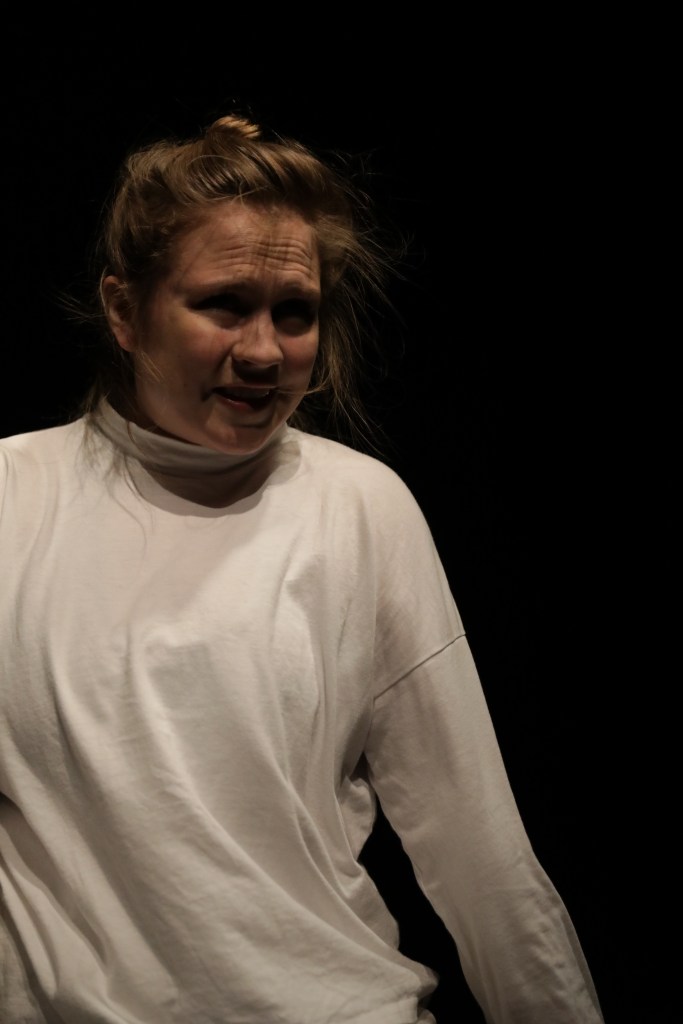
I remember rote sex positions, I remember pasta out of a tupperware, I remember the quiet, still sadness of heartbreak, I remember telling him I’m fine when I’m certainly not, I remember the calendar in my bedroom, green tea incense, my vibrator, sweet songs that make me cry. The memories are palpable, that’s how it should be, but I can’t believe I am doing this in front of people. Taking off my pants. Sharing the way I breathe when I’m alone. I can’t believe I decided to do this. I feel myself being seen and it’s so much more than remembering subjugation and remembering my clamor for control, it is subjugating, I am clamoring for control. My mind sees my flaws, vulnerabilities, and failings through the eyes of my viewers, more punishing than they could ever be. Just as my dance does, my thoughts toggle between “I don’t matter, I am nothing” and “I have control, I have worth.” I’ve never felt more inside this dance and it hurts and I want to get out. I dance through it.
After I get off stage, I cry. Breathing hard from shaking my body, my face flushed simply from the eyes that have been on it, I sit down and feel almost horrified at what I’ve just done. I let them see all my soft parts! Satisfying and crushing, uncomfortable and messy and necessary! I was fragile and cracking open, they had me in their hands and I was breaking. I beg them, bent over on the carpeted floor of the dressing room, let me fall apart in your hands, let me be crushed but hold me up to the sunlight please. Let me be seen. I worry it looks gruesome but really it’s what I (we) do every fucking day.
I walk out of the dressing room with a smile for my friends. I hug people, thank people, try to make people feel more comfortable with what just happened with jokes and giggles. I continue to perform.
The next day, the next show, feels daunting, but different. I know what’s coming. The eyes on me will heighten everything and make me try to rush through the painful parts. My mind, in the quiet moments, will snap into cruel projections. I decide, since this is probably the last time I do this dance, to savor it. I decide to be in it for as long as I can, to take my time to make myself feel better when the dance hurts. My memories still hurt. I am still uncomfortable, nervous, intensely red-faced. But, this time, I care just a tiny bit less about their eyes on me. I soak up the heat of the lights more willingly. I cry in my dressing room after, but without thinking I might throw up.

A version of this dance once ended with a kind of assertion that I don’t care how I’m seen anymore, that I have control, or clarity, or “empowerment.” I used to roll my shoulders back, one hip cocked, a little self-righteous grin on my face. A bit of a women-power fuck you. But it felt disingenuous, like a false narrative I wanted to believe about myself, or wanted to believe was possible. My cycles don’t end. I say fuck off to shitty men more, but I haven’t figured out what to do with concurrently wanting their attention and love. My patterns, and the huge gross systematic patterns of patriarchy churn forward. Nothing is solved, but also, nothing stays the same. The dance now ends more cathartically. I shake and open vigorously, catapulting my body around the stage, and then staring at where I just was. I am not fierce or triumphant. I continue to wonder who I build my body for, even when I’m alone. But I build again and again and again until the again teaches me something.
So, of course dancing it again was different, and of course it was kind of the same. I feel crushed and proud, vulnerable and composed, empty and satisfied. Of course this dance of contradictions and conflations feels this way. Of course it’s still surprising.
 NORA RAINE THOMPSON